
Srinivasa Ramanujan (1887–1920) stands among the most extraordinary mathematical minds in history.
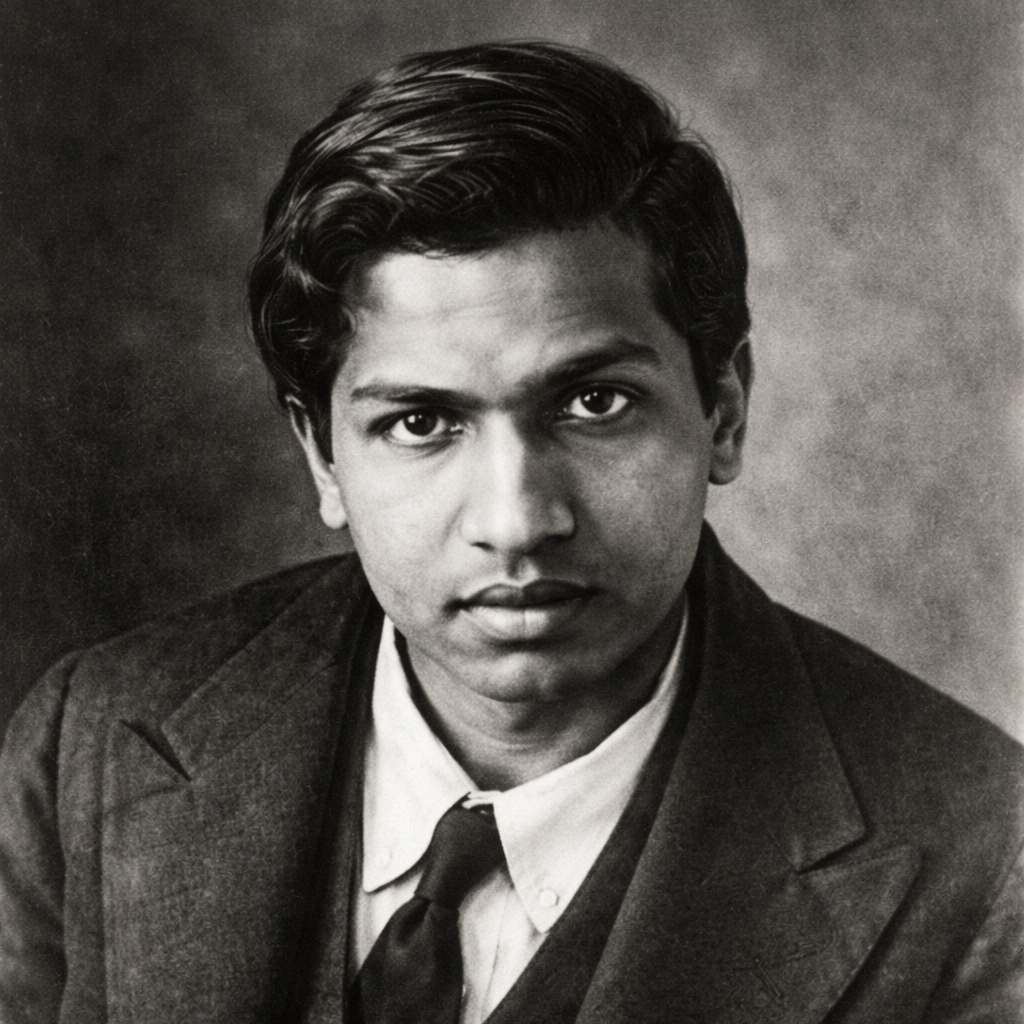
Srinivasa Ramanujan (1887–1920) stands among the most extraordinary mathematical minds in history. Largely self-taught and working in isolation during his early years, he developed groundbreaking ideas that would later reshape entire fields of mathematics.
With an intuitive and unconventional approach, Ramanujan made profound contributions to number theory, mathematical analysis, infinite series, and continued fractions. His work was not only innovative but often far ahead of its time—introducing concepts such as the Ramanujan prime, the Ramanujan theta function, and remarkable results on continued fractions and infinite series, which continue to influence modern mathematical research.
In 1913, his remarkable talent was recognized by the renowned mathematician G. H. Hardy of the University of Cambridge. This collaboration marked a turning point in Ramanujan’s life, bringing his work to the global academic stage. Hardy himself acknowledged the uniqueness of Ramanujan’s genius, noting that many of his results were unlike anything previously encountered.
Despite his short life, Ramanujan produced nearly 4,000 mathematical results, many of which were entirely original. His discoveries—including the partition formula, mock theta functions, and identities now known as Ramanujan–Hardy asymptotic formulas—have opened new pathways in mathematics and continue to inspire generations of researchers.
Ramanujan’s legacy extends far beyond his theorems. He embodies curiosity, perseverance, and the power of raw intellectual creativity. His journey—from modest beginnings to global recognition—serves as a powerful inspiration for young minds pursuing excellence in mathematics.
Today, his work remains a living source of discovery, reminding us that innovation often comes from thinking differently.
Largely self-taught, Ramanujan built advanced mathematical theories alone without formal education or structured academic training. His early work showed rare intuition and originality that surprised leading mathematicians worldwide.
Hardy quickly recognized his brilliance and helped bring his work to global attention and re
His discoveries still influence modern mathematics, inspiring continued research and new theoretical developments today.

The Ramanujan Challenge is inspired by Srinivasa Ramanujan, one of the most influential mathematicians in history, renowned for his extraordinary intuition and groundbreaking contributions to number theory, infinite series, and mathematical analysis.